
Hello friends—for the last decade or so, I’ve been a devoted follower of politics and current events. More recently, I’ve been doing quite a bit of reading and writing (especially about the economy and public policy) in a professional capacity. I’ve decided to start writing more, and for a wider audience, in a setting where I can share some of my original thinking.
This post was written before the tragic killing of Alex Pretti in Minneapolis yesterday. Right now, the fight to stop ICE’s assault on innocent Americans’ fundamental rights is paramount, led by the brave protestors standing up for their neighbors in Minnesota and across the country. The essay below speaks to a much longer-term question of the United States’ role in the world, one which can only be addressed after we secure democracy at home.
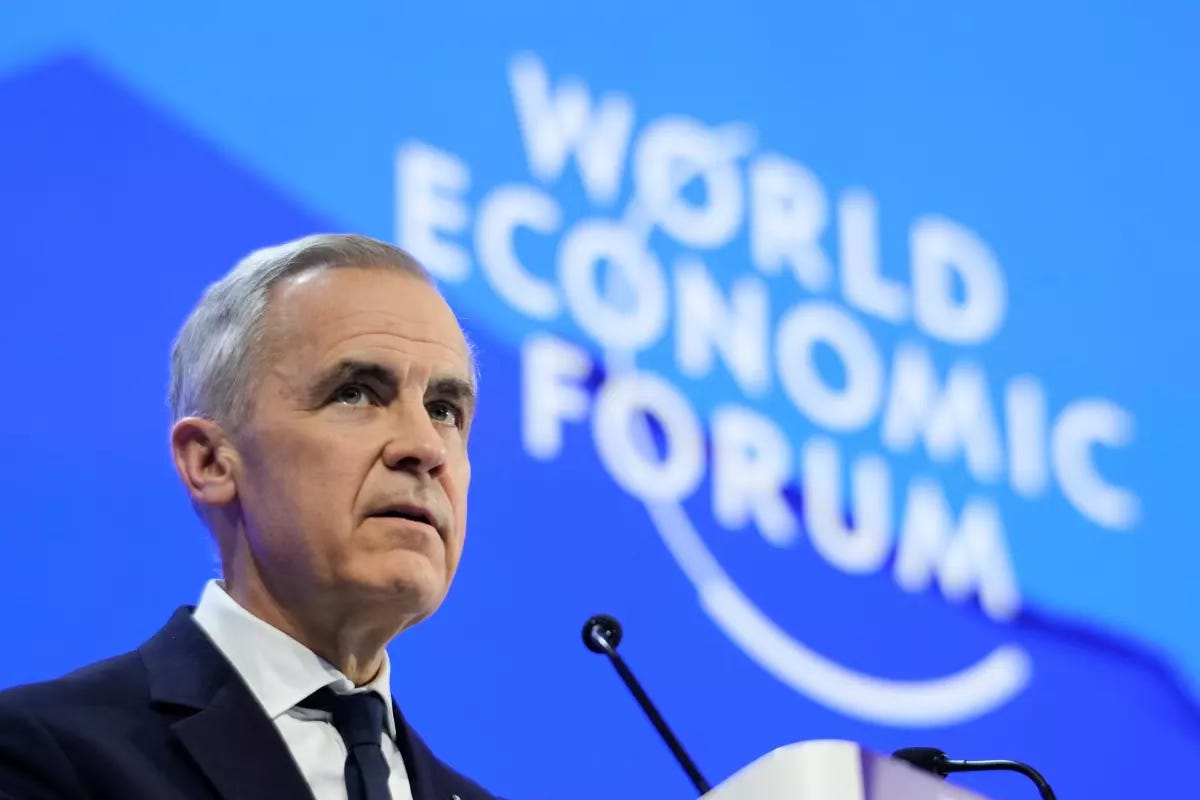
Earlier this week, Canadian Prime Minister Mark Carney delivered a speech at the World Economic Forum in Davos that shocked observers around the world and which may well mark a defining turning point in global politics. It’s 15 minutes, and if you have the time, I think it’s worth watching in full. The passage below especially stood out to me:
In 1978, the Czech dissident Václav Havel, later president, wrote an essay called The Power of the Powerless, and in it, he asked a simple question: how did the communist system sustain itself?
And his answer began with a greengrocer.
Every morning, this shopkeeper places a sign in his window: “Workers of the world unite.” He doesn’t believe it, no one does, but he places a sign anyway to avoid trouble, to signal compliance, to get along. And because every shopkeeper on every street does the same, the system persists – not through violence alone, but through the participation of ordinary people in rituals they privately know to be false.
Havel called this “living within a lie.”
The system’s power comes not from its truth, but from everyone’s willingness to perform as if it were true, and its fragility comes from the same source. When even one person stops performing, when the greengrocer removes his sign, the illusion begins to crack. Friends, it is time for companies and countries to take their signs down.
Carney, an economist-turned-central-banker and clearly a student of history, here inverts Havel’s critique of Soviet communism and directs it at the system that ostensibly brought it to an end—the liberal democratic global order led by the United States. In his telling, nations like Canada (and Europe, Japan, Australia, and so on) have been holding up the sign for the US-led system for decades, recognizing that while the story of that system is in part a lie, doing so has been, on balance, in their interest. Now, as the Trump administration seeks to weaponize the interdependence resulting from that system—not just against its enemies, but against its friends—the bargain no longer makes sense. “Middle powers” instead must band together and create newer, more flexible arrangements that can protect their interests and the values they hold dear.
One of the reasons Carney’s speech was so resonant is that in the days leading up to it, President Trump had been threatening a handful of European countries with tariffs if they did not assent to the US’s “Complete and Total purchase of Greenland.” The Greenland saga began at the start of Trump’s second term, and was originally mostly laughed off by observers who saw it as yet another of the President’s short-lived fixations. But after months of watching the US torch its relationships with other countries through an ill-conceived package of sweeping tariffs, and the subsequent illegal deposition of Venezuela’s Nicolás Maduro, the world was waking up to a new reality—Trump is increasingly unshackled from any real political or economic constraints, and therefore has the power to deal an immense amount of damage to the rest of the world if he chooses to. The response to this feeling was immediately felt in global stock markets, which rapidly sold off American stocks and the dollar on Tuesday in a reaction similar to that previously seen on “Liberation Day,” when investors began to doubt whether the US’s economic preeminence could hold.
Trump, for his part, appeared to back off from these threats soon after, pledging not to take Greenland by “excessive force” on Wednesday and dropping his threat of Greenland-related tariffs later that day. Some will look at this episode and see yet another episode of Trump “chickening out” in response to the first hint of resistance from the market, which he apparently uses as the yardstick of just how far he can go.
In a narrow sense, this is certainly true. Trump still has some Wall Street types—chiefly Scott Bessent—in his ear, and despite their loyalty oaths even they can see that Trump’s most extreme provocations threaten the stability of the financial system. But it would be premature to say that this walk-back puts the issue to rest.
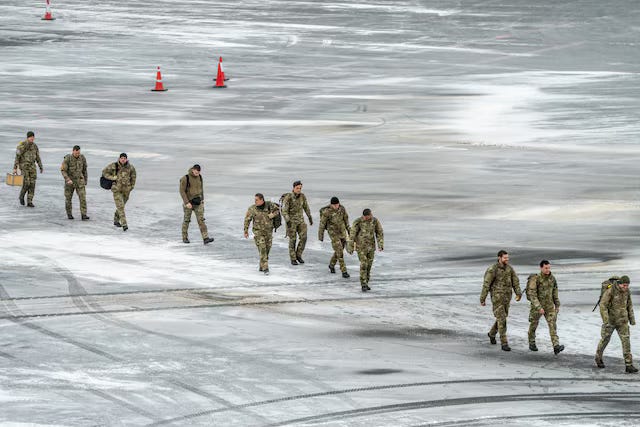
Consider what happened in the days following Trump’s threats. Several of America’s European allies—including Britain, France, Germany, and the Nordic countries—sent military reinforcements to Greenland to signal that even Trump’s far-fetched threats of military force would be taken seriously. Members of the European Parliament were prepared to freeze a pending US-EU trade deal and had teed up retaliatory tariffs on over $100 billion of American goods. Some were even considering the use of the so-called “bazooka option,” formally known as the Anti-Coercion Instrument (ACI), which would enable a sweeping shutdown on investment and services trade (such as contracts with US tech companies) in order to block America from wielding its leverage to get what it wanted. Now, the most extreme of these scenarios was likely never going to pass. But the fact that some of these options were even on the table is astounding. The ACI was proposed in 2021 in response to Chinese trade restrictions on Lithuania during a dispute over Taiwan. As any European leader would tell you, it is a tool of last resort, meant to protect Western Europe from interference by hostile great powers—especially authoritarian states like Russia and China. And yet, Trump brought the US scarily close to being its very first target.
Viewed from this perspective, it’s clear that Trump’s erratic moves count for more than just bluster. They have fundamentally altered the perceived reliability of the US as a partner around the world, and Carney’s speech strikes at the heart of that. Even if America elects a Democratic president in three years, it won’t change the fact that one of the two major parties in the US was able to elevate someone like Trump to the country’s highest office—and remains squarely behind him. So long as the median Republican voter is willing to advance someone with Trumpian politics out of a presidential primary, the threat will remain that his ideas make a comeback, which makes it imperative for other countries to plan for the worst. The radical takeover of the Republican party can no longer be written off as a one-time “aberration.”
We are already beginning to see the effects of this play out. Last week, Canada signed a fresh trade deal with China, most notably granting Chinese EV manufacturer BYD partial access to the Canadian market on a “most-favored nation” basis. This reversed Canada’s previous policy, which placed 100% tariffs on Chinese EVs, likely in coordination with the US’s own policy to the same effect. The immediate consequence of this will be to put American automakers (and, in turn, autoworkers) at a disadvantage, preventing them from scaling up production to the point where they could reasonably stand a chance of competing with China’s highly efficient production process. Canada is exploring similar deals with countries in Western Europe, the Middle East, and Southeast Asia (including those in the TPP, which the US walked away from in 2017). Europe is following suit, recently finalizing a deal with Mercosur, a bloc of South American countries including Argentina and Brazil. Germany, once secure under the umbrella of NATO, has now set a target of nearly doubling its military spending. None of these countries are disengaging from the US wholesale, but the search for alternatives is intensifying and will gradually erode the foundation of America’s leadership.
Why should Americans care? Should we care? Oftentimes in discussions about America’s role in the world, I find a first-order defense of the US’s value to be lacking. America is a democracy, but so what? It’s not obvious that a democracy wielding the reins of global military and economic power makes the rest of the world any more democratic. And as Carney, himself the personification of the globalist, liberal-democratic system said himself, the western “liberal order” has always been partly built on a lie—the US has often exempted itself from the rules it claimed it supported, whether by pursuing an illegal war of choice in Iraq or by turning a blind eye as American bombs fueled genocidal acts of aggression in Gaza. While this critique—which I have always found to be trenchant—is most strongly identified with the progressive left, a similar question has been posed to perhaps even greater effect by the new right. Does America’s role as a global superpower really serve Americans, or does it just act as a transfer from the rich to the poor, the strong to the weak?
Among these two, I find the far right’s critique much easier to dismiss out of hand. Americans enjoy enormous advantages from its preeminence in the world, ranging from the government’s ease of borrowing money during crises (compare America’s recoveries after the major recessions of this century to those of Europe) to the preferential treatment of American drugs, crops, and technology in international markets. Silicon Valley, Wall Street, and Big Pharma have certainly stood to gain from American-led globalism, but so too has the country’s middle class, which enjoys easy travel via passport to 179 countries, and gets to live in larger homes, go on fancier vacations, and purchase more appliances and consumer goods than their European peers.1 America’s leaders have, I think, done a terrible job of translating these gains into broad-based benefits for the working class and the poor, who face a much weaker social safety net than in other advanced countries and still have great difficulty securing access to healthcare, childcare, and housing. But this would be the fault of America’s regressive and backwards domestic politics, tinted by corruption and racial prejudice—a fault which remains eminently possible to correct if we can muster the political courage to do so.
The left’s critique bites harder. Especially for those of us growing up in the aughts, the post-World War II story of America as a shining city on a hill has never held full purchase. We learned that our country’s leaders committed and covered up heinous crimes in the name of a War on Terror. We watched the American electorate vote twice—the latter time by a popular plurality—for a campaign explicitly grounded in nativism and vengeance. We saw the credibility of many of our more “liberal” leaders crumble as they failed time after time to enforce America’s existing human rights laws, cloaking their defense of unfathomable war crimes in tightly scripted legalese. Perhaps it would be fairest to say that Gaza, not Greenland, marked the death knell for the liberal democratic order.
And yet, where does that leave us? My appraisal is that while America has always been a ruthless, self-interested superpower, there has also always been a streak of liberalism—a “better angel of our nature,” if you will—that has sometimes pushed us in a better direction. This streak, best thought of as one attitude among many of the American electorate and a faction of the American policy elite, explains some of our proudest achievements: interventions that halted ethnic cleansing in Bosnia and Kosovo,2 aid programs that saved tens of millions of lives from AIDS and malaria, special operations that stemmed the outbreak of Ebola and helped countless nations recover from natural disasters. Far more important than all of this are the mundane background changes that have occurred during this time: under the postwar system of open trade and common defense, the incidence of major war has declined around the world, hundreds of millions of immigrants have moved across borders (launching businesses, starting families, and gradually eroding the enduring barrier of racial difference), and over two billion people have been lifted out of extreme poverty. Literacy, food security, the status of women, and life expectancy have all made meteoric strides during this period.
It would be hyperbolic to attribute all of this to the United States, but the “rules-based” system has provided the framework under which this progress has been made. America’s navy has secured global sea lanes, making international exchange possible. NATO’s protection has enabled Western European states to invest more in humane domestic policies. The norm of sovereignty—however imperfectly enforced—has helped limit escalation in some of the most conflict-prone zones in the world. The question in front of us is as follows: do the actions of a fickle liberal faction in American politics justify the continuation of such an unbalanced and risky system? Or is the world better off starting anew? Certainly, Carney is right that if the US continues down its current path, the remaining democracies of the world will have no choice but to build something different. But we should not be naive about how difficult that will be. Without the support of one of the world’s major powers, these nations will struggle to exercise autonomy over important decisions related to security and economic growth. They will pursue a policy of “values-based realism,” as Carney terms it3—that is, their ability to pursue their values of freedom, tolerance, and human rights will be constrained by the cold realities of international politics. It is no coincidence that Carney’s pitch, hailed by liberals in the United States, coincides with his government’s right-leaning agenda to cut taxes on the wealthy, boost fossil fuel production, double defense spending, and engage more deeply with rights-abusing states like Qatar. These are the “realistic” choices that countries make when they stare down a fragmented and hostile international environment, and they are likely to become more common in the years ahead.

An unsentimental—one might say realist—view of the situation is that Carney has laid out a rational path for countries to follow under fairly pessimistic assumptions about the United States. If the US remains a rogue and unpredictable actor, better to try a go at it alone alongside your like-minded peers. As an American, I admire Carney’s resolve but must protest his conclusion. I would much prefer to see a world where the US reverses the damage to its international reputation and seeks to engage with the rest of the world constructively. It is unlikely that we will return to the era of unipolar dominance that followed the immediate end of the Cold War; nor should we. But even if all democracies are condemned to live in a world of “values-based realism” for the foreseeable future, they will still be far better off with America on their side. A US that is constructively, even if imperfectly, engaged with the democracies of the world will provide an economic and military heft that unlocks more options for the world to move in a more progressive direction. It will enable countries to coordinate their efforts on thorny issues related to energy, security, and trade, reducing the need for short-termist actions that threaten the environment, the poor, and human rights.
No other major power can fulfill this role. Relative to the alternatives, the US is still unique for its relatively democratic political culture and for its diversity of background and thought. China, despite its major progress in human development, remains a racially homogenous and exclusionary authoritarian state, which sustains its immensely unequal state capitalist system with the brutal suppression of speech rights, labor rights, and the freedom of movement.4 The case against Russia writes itself. So long as the majority of the world’s population remains under undemocratic governments, achieving true global justice for all will remain impossible, but there are real ways in which the actions of the world’s democracies can help. I believe that progressives in the United States, despite their well-justified skepticism of America as a force for good, should want our country to seek to live up to those ideals and once again aim to lead—perhaps this time, partner with—like-minded nations who value the same things we do.
Doing this means, first and foremost, attacking Trumpism at its root. On this, progressives have ideas. The next few years will witness a heated debate about affordability and the economy, and will offer Democrats a fresh chance to prove that they can offer a better deal for America’s strained middle class. Trump’s drastic missteps have created a major opening for the left, and I am optimistic that they can ultimately find a way to settle their differences and meet the moment. However, winning a single election will not put the issue to rest. Progressives will need to offer American voters a better story about how the US should navigate social change and engage with the rest of the world, including making potentially difficult choices around America’s openness to immigration and cultural identity. Moreover, they will need to actually deliver the sustained economic improvement they promise, a task which is easier said than done. Ultimately, they will need to persuade a critical segment of voters that their current perception of the two parties is wrong, and that Democrats reliably offer a better bargain—thereby reshuffling both parties’ political coalitions enough to dislodge Trumpian politics from their iron grip on the GOP.
This task alone is a tall order, and more than enough to be the singular focus of the left for the next few years. My hope is that, should they gain some traction in doing so, they do not lose sight of the stakes for the rest of the world. We should not allow the sins of our nation’s past to destroy our will to build something better. Absolutely, those faults should compel us to act with humility, and to push for sweeping reforms that will raise standards, democratize international institutions, and create real accountability for our leaders. And yet, walking away from the rest of the world will be worse for virtually every goal that progressives care about. The signs may be coming down today for good reason. We, the opposition, should do everything in our power to make it worth putting them back up.
None of this is to say that America is a better place to live than Europe, which trades some material prosperity for a stronger social fabric, more third spaces, healthier food, and so on. Personally, I would love to see the US invest more in building dense cities with robust public services. But global engagement doesn’t preclude this (as a highly integrated Europe shows), and making the US poorer by turning away from the rest of the world won’t make improving quality of life any easier. I also acknowledge the critique advanced by Matthew Klein and Michael Pettis in their book Trade Wars Are Class Wars, which is that the form that US-led globalization has taken has disadvantaged American industrial workers while fueling a boom of cheap credit. This is a strong argument for revising the terms of globalization to address existing imbalances, and possibly for a more managed approach to integration in the future. It doesn’t overturn the overall logic that positive-sum cooperation between countries will generally enlarge the pie and enable us to raise living standards if we choose to distribute the proceeds well.
This sentence does not do justice to the complex debates about humanitarian intervention that continue to rage. I believe the US’s actions ultimately did more good than harm in these cases, and that there is is a strong case that our leaders should have moved far more decisively to avert the tragedies of the 1990s.
Separately, China has made a powerful pitch to developing countries that it can be a more reliable partner for economic development, and is pushing ahead of the US on essential goals like building renewable energy. On these and other issues where American liberals find agreement, we should absolutely seek to cooperate with rather than antagonize China, and to strengthen the US’s own comparative appeal as a faithful partner to developing nations.
Places and symbols outlive the conditions that made them meaningful, and we keep them up out of inertia more than belief. Letting it go reads like loss, but it’s usually the first honest moment in years.